
Irrigation Retrofits That Improve Water Efficiency in Existing Yards
A lot of existing yards waste more water than their owners realize, not because anyone set out to overwater, but because the landscape was built for a different climate, a different plant palette, or a different idea of what “finished” should look like. The old spray system still runs, the turf still demands more than the site can comfortably give, and the planting layout may have never been matched to sun, slope, or soil. In the San Gabriel Valley, where water-wise design has become part of the landscape conversation rather than a niche specialty, irrigation retrofits are often the fastest way to reduce waste without tearing the yard apart.
The best retrofits do not start with equipment. They start with observation. That means looking at how water moves through the yard, where it disappears too quickly, where it pools, and which parts of the landscape have very different needs even if they sit only a few feet apart. California water guidance points landowners toward exactly that kind of assessment before removing turf or reworking a site, with attention to irrigation, soil, sun exposure, and plant selection. That sequence matters. If you skip it, you can end up with a prettier system that still performs badly.
Where the water is actually going
Most inefficient yards have a few predictable trouble spots. Spray heads hit pavement and hardscaping instead of plant material. Turf and shrubs share the same zone even though they need very different amounts of water. Slopes receive runoff because the system applies water faster than the soil can absorb it. In older landscapes, this problem is often hidden by habit. The yard looks green enough from the street, but the controller may be running on a schedule built around guesswork rather than actual plant needs.
Retrofit work usually begins with a zone-by-zone audit. Not a theoretical one, but a practical look at what each area is doing during a cycle. Are the nozzles overlapping correctly, or are they throwing beyond the planted area? Are there dry strips because the spray pattern is broken or blocked? Does water run downhill before it has a chance to soak in? On hillside landscaping, this last question is especially important. Slopes need erosion control, drought tolerance, and firewise planting, which means irrigation has to be tuned to the terrain instead of treated like a flat suburban lawn.
A good retrofit often uncovers a surprisingly simple truth: the yard is not underplanted, it is miswatered. I have seen compact front yards where half the turf looked thirsty while the other half stayed soggy simply because the heads were mismatched and the lawn areas were tied together on one zone. Once those were separated and adjusted, the landscape immediately behaved better without a single plant being replaced.
Smarter irrigation hardware, used with restraint
Hardware changes can make a large difference, but only when they fit the landscape. Drip irrigation is often the most useful retrofit for shrub beds, native plant areas, and mixed drought resistant landscaping because it puts water close to the root zone and reduces overspray. It is especially effective where plants are spaced out or where the soil takes water slowly. For many existing yards, converting selected beds from spray to drip is more valuable than replacing every part of the system at once.
That said, drip is not a cure-all. It needs good filtration, pressure regulation where appropriate, and regular checking for clogging or damage. In areas with ridgelineoutdoorliving.com varied plantings, especially landscape design that mixes ornamentals with native or climate-appropriate plants, drip lines should be arranged with some judgment. A row of California sagebrush should not be treated the same way as a thirstier foundation shrub. WUCOLS, the region-appropriate plant water-use guide California points homeowners toward, is useful precisely because it reminds people that plant water needs are not one-size-fits-all.
Rotary nozzles or other more efficient spray components can also help where turf remains necessary or where certain groundcover areas still need overhead coverage. The point is not to make every zone the same. The point is to reduce overspray, improve infiltration, and match the delivery method to the plant material and terrain.
Controllers matter too. A retrofit that leaves an old controller in place can only go so far. Weather-aware or schedule-based controllers can improve efficiency if they are set carefully and not treated like a set-it-and-forget-it gadget. The real gain comes when the schedule reflects the site’s conditions rather than a generic assumption about how long “lawns” or “shrubs” should run.
Turf reduction, done with an irrigation plan in mind
A lot of people think about turf removal as a plant choice alone, but from a water-efficiency standpoint, it is an irrigation project as much as a design project. California’s water conservation guidance and the state’s Model Water Efficient Landscape Ordinance both push landscapes toward efficient irrigation, climate-appropriate plants, and alternative water strategies where appropriate. That broader framework matters because removing turf without revising the irrigation system can leave abandoned spray heads, dead zones, or runoff problems.
When turf is reduced, the irrigation retrofit should follow the new shape of the landscape. If a lawn is shrinking into a smaller activity area, the old wide spray coverage probably no longer makes sense. If lawn is being replaced with native planting beds, the system should be reconfigured to deliver water only where plant roots actually need it. In practical terms, that means capping unnecessary lines, resizing zones, and rerouting water delivery to reflect the new layout.
The best turf conversions are also honest about use. Some yards need a patch of lawn for children, pets, or simple function. Water efficiency does not require eliminating every square foot of turf. It requires deciding which areas earn their water and making sure the rest of the landscape is not subsidizing a habit that no longer fits the site.
Slope, runoff, and the hard lessons of hillside landscaping
In hillside landscaping, water efficiency and erosion control are tied together. A poorly tuned system on a slope can waste water and move soil at the same time, which is a bad combination anywhere but especially in foothill properties. Water that runs too quickly down a grade does not irrigate the root zone evenly. It can also carry sediment, strip mulch, and leave shallow-rooted plants struggling.
This is where irrigation retrofits need to work hand in hand with landscape design and hardscaping. Small grade changes, soil amendments where appropriate, and discreet physical barriers can slow water long enough for it to soak in. In some yards, a narrow hardscaping element, such as a low retaining detail or a carefully placed terrace, can help interrupt runoff and create safer planting pockets. The point is not decorative effect alone. It is control.
On slopes, shorter irrigation cycles with rest periods between them often work better than long, continuous runs. That gives the soil a chance to absorb water instead of shedding it. Zones may need to be broken into smaller sections so upper and lower parts of the slope are not treated as identical. This is one of those cases where a retrofit is less about adding technology and more about respecting the shape of the land.
The San Gabriel Valley’s hillside visual character also makes this more than a technical issue. Water-efficient landscapes need to look intentional in steep settings. Sparse planting on a slope can look unfinished or exposed, while the wrong mix can feel heavy and out of place. A thoughtful retrofit considers both performance and appearance, especially in neighborhoods where the landform is part of the identity of the place.
Plant selection and irrigation should be designed together
People often ask whether irrigation retrofits can “save” a landscape that was planted badly. Sometimes they can, but only up to a point. If the plant palette demands more water than the site can sustainably provide, the irrigation system will always be compensating for a mismatch. That is why California’s guidance emphasizes evaluating plant selection along with soil and sun exposure. The irrigation system can only be as efficient as the landscape around it.
This is where California native plants and other climate-appropriate selections earn their place. In the San Gabriel Valley, plants such as California buckwheat, California sagebrush, manzanita, ceanothus, monkeyflower, foothill penstemon, bunchgrasses, and the locally named San Gabriel oak fit naturally into water-wise design conversations. These plants are not simply popular because they are native. They are useful because they align with drought tolerant landscaping strategies and, when placed properly, reduce the need for constant irrigation adjustments.
The microclimate of the yard still matters. A sunny exposed edge will not perform like a protected courtyard. A plant that thrives on a slope may struggle in dense shade, and vice versa. Efficient irrigation is not achieved by giving every bed the same amount of water. It is achieved by grouping plants with similar needs and then watering each group accordingly. That sounds simple, but it is often the difference between a yard that merely survives and one that settles in.
CNPS guidance on hot, sunny slopes is especially relevant here. Slopes demand plants that can hold soil, handle heat, and tolerate leaner watering. That is the kind of place where bunchgrasses, low woody shrubs, and well-chosen natives can outperform a thirsty, shallow-rooted mix every time. When the plant palette is right, the irrigation retrofit becomes easier and more precise.
Firewise planting and water efficiency can work together
In this region, firewise landscaping is not a separate conversation from water efficiency. The two overlap in meaningful ways. Native and climate-appropriate plants, arranged with attention to defensible space and ember-resistant zone rules, can support both goals. That does not mean every drought-tolerant plant is automatically fire-safe or that every low-water yard is automatically protected. It means the retrofit should be informed by both water needs and fire considerations.
A yard with dense, overwatered plantings and inefficient spray heads can create maintenance problems and unnecessary fuel buildup. A yard redesigned around appropriate spacing, cleaner transitions, and more restrained irrigation can be easier to maintain and less dependent on constant intervention. In the San Gabriel Mountains region, where native habitat gardening intersects with fire concerns, this balance matters even more. The landscape should fit the site, not fight it.
Good irrigation retrofits support this by avoiding excess moisture where it does not help the plants, and by keeping the system from encouraging weak, overly lush growth in places that are better managed lean. That does not mean underwatering. It means using water where it actually produces healthy structure and not just superficial growth.
HOA rules, drought restrictions, and practical reality
For many homeowners, the biggest obstacle is not technical, it is social. HOA expectations can make people reluctant to change visible landscape features, especially turf. California’s water restriction guidance is clear that homeowners’ associations cannot prohibit certain water-efficient landscaping choices during drought-related restrictions. That matters because many retrofits are delayed simply because people assume they will need permission to make responsible changes.
Even with that protection, good communication still helps. A retrofit that replaces wasteful irrigation with smarter delivery, native plantings, and clearer maintenance patterns often looks more intentional than a struggling lawn ever did. If the design is clean, people tend to notice the improvement rather than the loss. In fact, some of the most successful retrofits I have seen were initially framed as maintenance fixes, then became full landscape upgrades once the property owners saw how much better the yard functioned.
That is one reason to think in phases. A homeowner may not be ready to remove all turf or redo every planting bed in one season. But they may be ready to fix the worst-run zones, convert a bed to drip, or rework a slope that has been wasting water for years. Those partial improvements still matter.
A retrofit sequence that actually holds up
The most reliable retrofit sequence is almost always practical and site-specific. Start with the landscape as it exists, not as you wish it were. Then decide where water is being lost, where the soil is failing to absorb it, and where plant selection is driving unnecessary demand. From there, match irrigation method to plant type, break up mixed zones, and pay special attention to slopes, run-off, and any hardscaping that changes how water moves.
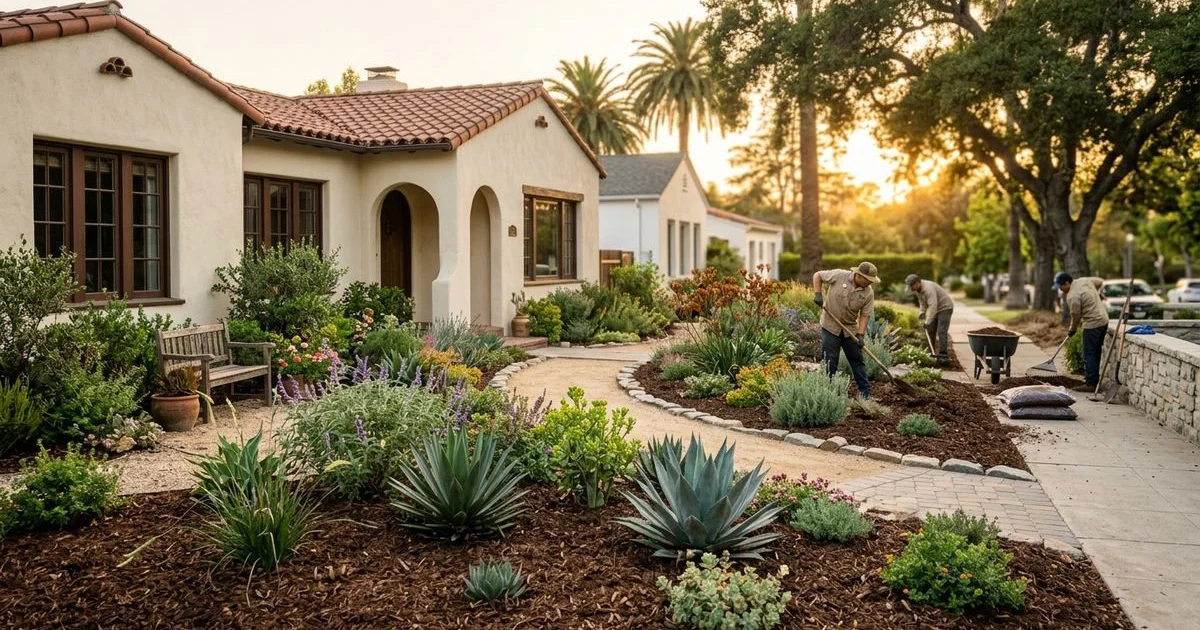
For many existing yards, the highest-value changes are not dramatic. A few adjusted nozzles, a converted shrub bed, a reprogrammed controller, and a better plant grouping can change the whole performance of the landscape. In larger or more difficult sites, especially hillside landscaping, the retrofit may also require drainage adjustments, erosion control, and some rethinking of the visual structure. That is where landscape design earns its keep. Efficiency should not look accidental.
Here is a short field-tested way to think about the work:
That sequence is not glamorous, but it prevents a common mistake: spending money on upgrades that look modern while the yard still behaves inefficiently.
The retrofit is really a design decision
People tend to talk about irrigation retrofits as plumbing fixes, and they are partly that. But the deeper value is design. A well-retrofitted yard reflects the realities of California water conservation, the rules that shape renovated landscapes, and the local conditions of the San Gabriel Valley. It respects sun exposure, soil behavior, plant water needs, slope, and fire risk. It gives hardscaping a functional role rather than letting it become a source of runoff. It supports drought resistant landscaping without pretending every part of the yard should be identical.
The yards that age best are usually the ones where irrigation and planting were finally made to agree with each other. Water stops being a vague expense and becomes a controlled input. The landscape looks calmer because it is no longer being forced into a system that does not fit. That is the real payoff of a retrofit: not just lower water use, but a yard that finally makes sense on its own ground.