
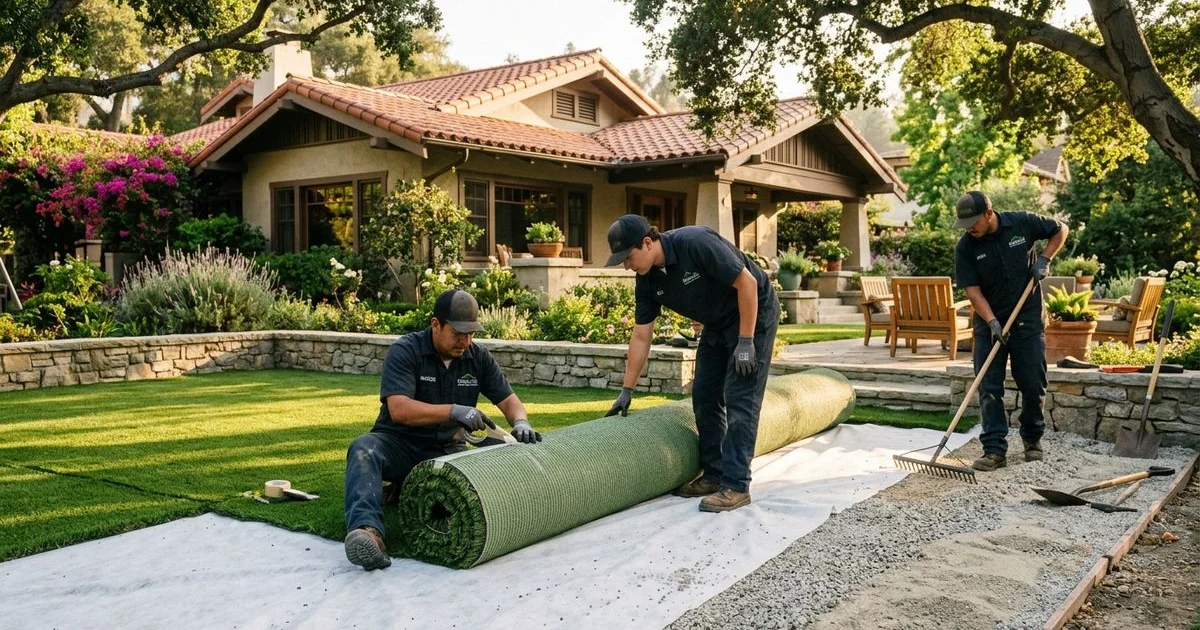
Drought-Resistant Planting Ideas for Warm, Dry Climates
Warm, dry climates reward good planning and punish guesswork. A planting scheme that looks generous in spring can collapse by midsummer if it depends on too much water, shallow roots, or plants that never had a chance in the first place. The better approach is not to fight the climate, but to design with it. That means reading the site carefully, choosing plants that suit the heat and the soil, and using hardscaping and irrigation as part of the planting strategy rather than afterthoughts.
In places like the San Gabriel Valley and the foothills below the San Gabriel Mountains, drought resistant landscaping is not just a style preference. It is a practical response to water conservation, hillside conditions, fire risk, and the visual character of the region. New construction, renovated yards, and long-established properties all face the same basic question: how do you create a landscape that looks finished, functions well, and does not demand a constant fight against the climate?
The answer usually starts before any plant goes in the ground.
Start with the site, not the shopping list
The most successful landscape design begins with observation. Before removing turf or sketching planting beds, it helps to understand how water moves through the property, where the soil holds moisture, which areas bake in full sun, and where afternoon shade offers some relief. California’s water conservation guidance emphasizes exactly that kind of assessment, because plant choice alone does not solve a poorly matched site.
A slope, for example, behaves very differently from a flat front yard. Water tends to run off instead of soaking in, which means the top of the slope can dry out quickly while the lower sections stay wet longer after irrigation or rain. That is why hillside landscaping often needs a blend of erosion control, drought tolerance, and firewise planting. On a hillside, a beautiful plant that spreads aggressively by seed may be less useful than one with a dense root system that helps hold soil in place. Even a modest change in grade can affect how much irrigation is actually reaching the root zone.
Sun exposure matters just as much. A plant that thrives in morning sun and filtered afternoon light can struggle badly on a south-facing slope with reflected heat from a wall or paved area. Likewise, shaded pockets under eaves or mature trees may need a different plant palette and less frequent watering than the rest of the yard. Microclimate is not a theoretical concept. You can usually feel it on a hot afternoon, where one corner of the property feels several degrees hotter than another.
Soil deserves attention too. Heavy clay, compacted fill, decomposed granite, and disturbed soil from construction each create different planting conditions. If the drainage is slow, roots may sit in water too long after irrigation. If the soil is too loose and fast draining, moisture may disappear before plants can use it. In either case, the right planting plan and irrigation strategy can make a dramatic difference.
Why regional plant choice matters more than wishful thinking
A dry climate landscape works best when it leans into plants that are already adapted to seasonal drought, strong sun, and, in some locations, the additional stress of wind or slope. The California water agency points gardeners toward region-appropriate plant water needs, and that idea matters more than any fashionable plant palette. The label “drought tolerant” is too broad to be useful on its own. Some plants survive drought once established but still need regular water for a long stretch after planting. Others handle heat beautifully but fail in poorly drained soil. A successful plan looks beyond the label and asks how each plant behaves in the actual yard.
This is where California native plants often earn their place. They are not the only answer, but they are frequently a strong one for warm, dry climates, especially in the San Gabriel Valley and adjacent foothill communities. California buckwheat, California sagebrush, manzanita, ceanothus, monkeyflower, foothill penstemon, bunchgrasses, and San Gabriel oak all fit naturally into landscapes that need restraint, texture, and resilience. These plants also support native habitat gardening, which gives the yard a function beyond appearance.
There is a subtle advantage to using plants that belong to the region. They tend to look at home with local architecture and terrain. A dry garden built around California native plants often feels more convincing than one assembled from generic “desert” plants that could be anywhere. That local character matters in the San Gabriel Valley, where hillside landscapes and view corridors are part of the visual identity of many neighborhoods.
Planting ideas that work in warm, dry climates
The most durable planting schemes usually combine structure, layering, and restraint. Instead of packing the yard with thirsty shrubs and scattered annual color, think in terms of bones, texture, and seasonal interest.
One practical approach is to anchor beds with a few structural shrubs or small trees, then weave in lower plants and grasses that can fill space without creating a water burden. Manzanita can bring year-round form and a distinctly California look. Ceanothus can add depth and seasonal bloom while still fitting a water-wise plan. California sagebrush contributes soft texture and a silvery cast that reads well in bright sun. Bunchgrasses offer movement and help soften edges, especially near walkways and hardscape transitions.
Foothill penstemon and monkeyflower are useful where a bit of color is wanted without committing to high-water ornamentals. Their value is not just in bloom, but in the way they keep a planting bed from feeling static. Used thoughtfully, they create rhythm through the growing season without requiring the constant replacement that annual bedding plants often demand in hotter climates.
Groundcovers deserve careful selection too. In a drought resistant landscaping plan, the goal is not to carpet every inch of soil with a plant that grows too fast and needs continual trimming. The better groundcover is one that can handle the site, reduce bare soil, and limit evaporation. On slopes, that can also mean the difference between a tidy planting and a patch of exposed soil that erodes during irrigation or a sudden rain.
It is also worth remembering that not every area should be planted densely. Some spaces are better handled with a combination of plants and open material, especially where visibility, maintenance access, or drainage is a concern. That is where hardscaping can support the planting design rather than compete with it.
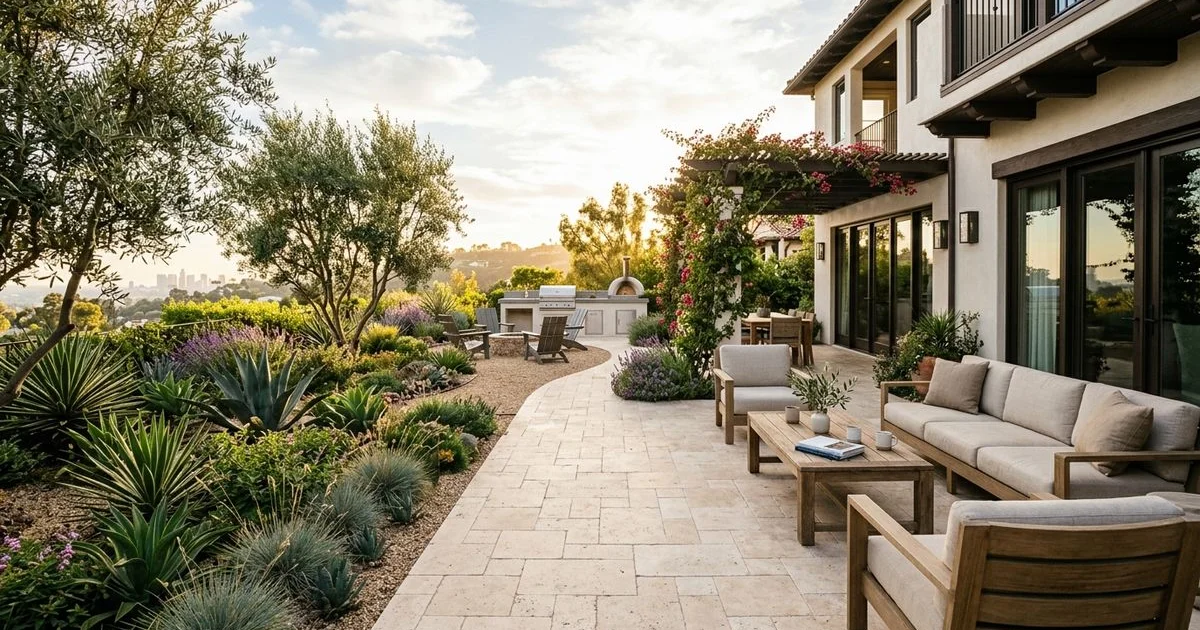
Hardscaping as a planting partner
Hardscaping often gets treated as the opposite of planting, but in warm, dry climates it is one of the most useful tools available. Walkways, retaining edges, decomposed granite paths, rock mulch, and other nonliving elements help shape how water moves and where people walk. They also create breathing room between planted areas, which can reduce maintenance and help avoid a crowded look.
In practical terms, hardscaping can solve problems that plants cannot. A narrow side yard with intense reflected heat may be better served by a path and a few well-placed shrubs than by a full planting bed that struggles to survive. A slope may need structural elements that slow runoff and give roots time to establish. A front entry may benefit from a combination of drought adapted plants and hardscape features that frame the home without demanding weekly watering.
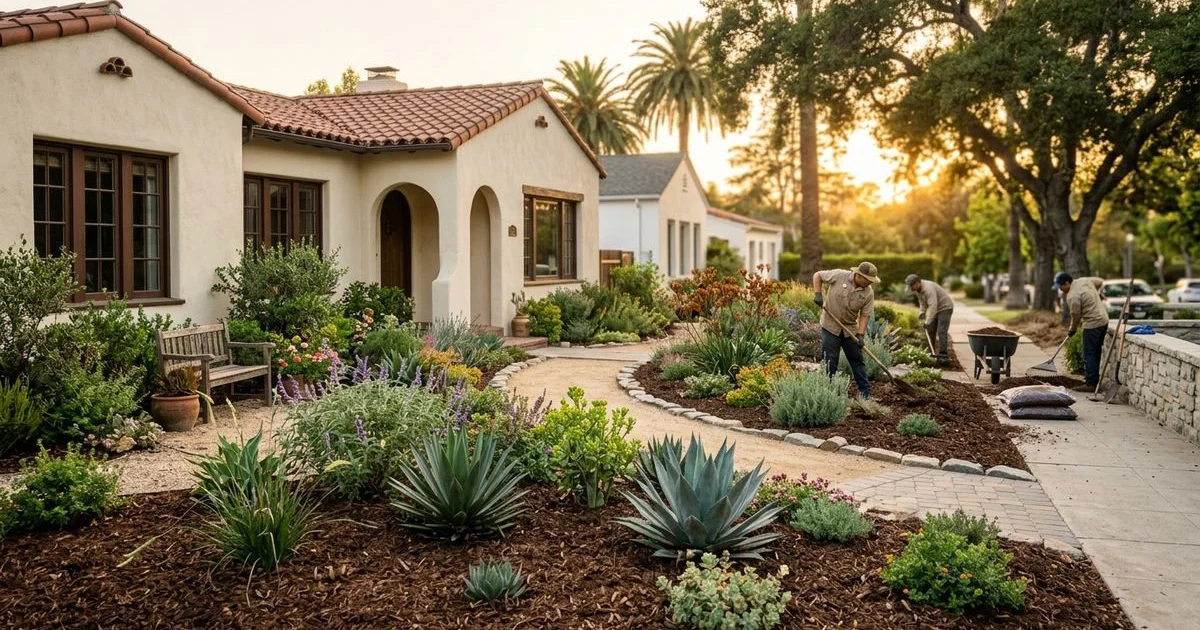
Good hardscaping also improves the way a landscape ages. A gravel or stone edge around a planting bed keeps mulch from washing away. A carefully placed path can give access to irrigation components and maintenance points without trampling the root zones of established plants. In a real yard, these details matter. They are the difference between a landscape that looks good in a render and one that can be maintained year after year.
Irrigation retrofits and water discipline
Even the best plant palette will struggle without sensible irrigation. California guidance encourages homeowners to assess irrigation as part of the landscape planning process, and that advice is especially important in dry climates. A retrofit can often do more for plant health than adding another layer of amendment or mulch.
Drip irrigation is often a strong choice for drought resistant landscaping because it places water close to the root zone and reduces waste. That said, drip is not magically correct in every situation. It needs to be laid out with the actual plant sizes, soil conditions, and slope in mind. On a hillside, emitters may need to be arranged carefully so water is not simply running downhill instead of soaking in where it is needed. In deeper planting beds, irrigation coverage should match the mature spread of the plants rather than their size at installation.
Newly planted drought tolerant species still need regular attention during establishment. The common mistake is to assume that “low water” means “no water.” In warm climates, a young plant with undeveloped roots may decline quickly if it is starved of moisture too soon. After establishment, the watering schedule can usually be stretched, but the first season or two sets the foundation.
Mulch remains useful, but it should be used with judgment. It helps moderate soil temperature and slows evaporation, yet it does not replace irrigation or correct a bad plant choice. On a slope, mulch may also need to be paired with other erosion control measures so it does not migrate downhill.
Hillside landscaping needs a different standard
Hillside landscaping in the San Gabriel Valley and similar regions deserves its own conversation because slopes combine several stress points at once. They dry out faster, they are harder to irrigate evenly, and they can be more exposed to erosion and fire risk. CNPS guidance on hot, sunny slopes emphasizes the need for erosion control, drought tolerance, and firewise planting, which is exactly the right framework.
For a slope, plant spacing matters more than people expect. If plants are too far apart, the soil stays exposed longer and erosion becomes more likely. If they are packed too tightly, maintenance becomes difficult and water demand can rise. The sweet spot is usually a layered matrix of plants with different root habits and canopy forms, supported by soil preparation and irrigation that are specific to the grade.
The visual effect also matters. A hillside can look either sparse or gracefully planted depending on the mix. Bunchgrasses can break up large stretches of slope, while shrubs such as ceanothus and California sagebrush help establish rhythm and mass. Lower plants, including monkeyflower and foothill penstemon, can soften transitions between terraces, paths, and larger shrubs. The best hillside landscaping usually avoids a repetitive grid and instead works with irregular but intentional repetition, so the slope feels natural without looking random.
Firewise planting and defensible space
Warm, dry climates often overlap with wildfire concerns, so planting choices should support defensible-space planning. That does not mean a yard has to look barren or overbuilt. It means selecting plants and arranging them with clear maintenance, spacing, and access in mind. The CNPS San Gabriel Mountains chapter notes ember-resistant zone rules and native plants suitable for local gardens, which reinforces a practical point: resilience and beauty do not have to be separate goals.
Firewise landscaping starts with reducing fuel continuity. Dense, ladder-like layers that allow fire to move from low plants to taller shrubs and into tree canopies are not ideal near structures. Openings, setbacks, and thoughtful groupings help reduce that risk. Hardscaping can help here too, providing noncombustible breaks near the home and around access points.
Plant selection matters, but so does maintenance. A drought tolerant shrub that is left overcrowded, deadheaded poorly, or allowed to accumulate dry debris can become part of a fire problem. In other words, plant choice buys you a better starting point, not immunity. Firewise design works best when the planting plan is paired with regular upkeep.
Landscaping rules, HOAs, and practical constraints
Homeowners sometimes assume they expert landscape craftsmanship cannot make water-wise changes because of association rules, but California water restriction guidance makes clear that homeowners’ associations cannot prohibit certain water-efficient landscaping choices during drought-related restrictions. That does not remove every community guideline, but it does strengthen the case for drought resistant landscaping when water conservation becomes a serious concern.
In new or renovated landscapes, the Model Water Efficient Landscape Ordinance also shapes the conversation. It encourages climate-appropriate plants, alternative water sources, and efficient irrigation. For property owners, that means the landscape is no longer judged only on appearance. Water use is part of the design brief.
This is one reason local planning documents increasingly acknowledge drought-tolerant plantings and water-efficient landscapes in the San Gabriel Valley, especially where hillside visual character matters. The region has a strong identity, and the challenge is to preserve it while working within water limits and site conditions.
A practical plant palette for the region
If I were sketching a planting plan for a warm, dry yard in this part of Southern California, I would start with a restrained core palette and then fine-tune it to the site. California buckwheat can provide structure and seasonal bloom. California sagebrush adds softness and a distinct native texture. Manzanita and ceanothus can carry the backbone of the design. Monkeyflower and foothill penstemon can bring color in smaller doses. Bunchgrasses can unify larger spaces and help the landscape move visually. San Gabriel oak, where appropriate, can bring a stronger native identity and long-term character.
The key is not to use everything at once. Too many species, arranged without a clear purpose, can make a drought tolerant landscape look busy rather than coherent. A better strategy is to repeat plants where they make sense, let a few species do the heavy lifting, and reserve diversity for spots where it adds real value such as slope stabilization, habitat support, or visual contrast.
For most properties, the right mix will also include intentional open space, paths, or other hardscaping elements. That balance is what keeps the landscape from becoming either too barren or too crowded.
What makes these landscapes succeed over time
A drought resistant planting plan succeeds when it respects three realities at once. First, warm dry climates are unforgiving of mismatched plants. Second, irrigation and drainage are part of the design, not separate chores. Third, the most attractive landscape is usually the one that fits the site and the region instead of resisting them.
That is why careful plant selection, hillside landscaping strategies, firewise planning, and hardscaping all belong in the same conversation. A yard in a place like the San Gabriel Valley can be water-wise, visually strong, and ecologically meaningful without looking sparse or generic. But it takes discipline at the start, and some patience afterward.
The best results usually come from slow, deliberate choices. Assess the sun, soil, slope, and irrigation first. Use native and climate-appropriate plants where they fit. Keep hardscaping purposeful. Treat the hillside differently from the flat pad. Make space for firewise planning. And remember that the landscape’s job is not to demand constant rescue, but to settle into the climate and hold its own through long, hot stretches.