
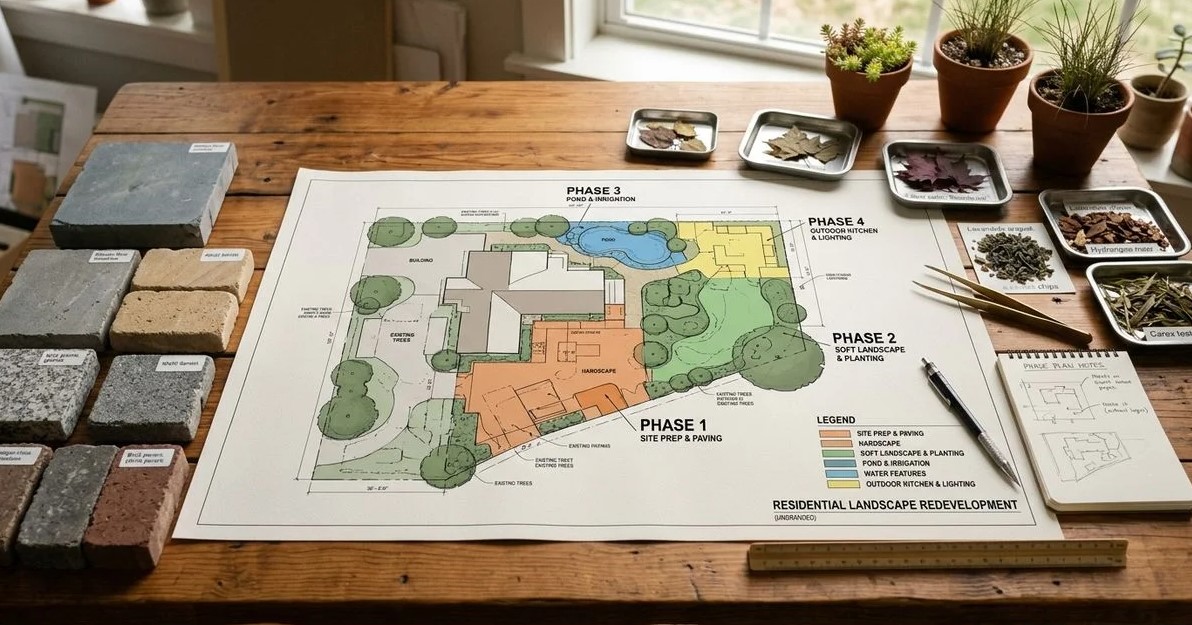
Front Yard Landscaping Ideas with Native California Plants in Santa Ana CA
Santa Ana front yards ask a lot from a landscape. They sit through long dry stretches, reflect heat off pavement and stucco, and often take the full glare of afternoon sun. At the same time, they carry a lot of visual weight. The front yard is what neighbors see first, what frames the architecture of the house, and what quietly signals whether a property feels current, cared for, and suited to Southern California.
That is why native California planting makes so much sense here, especially when it is paired with thoughtful hardscaping and a layout that matches the scale of the lot. A good front yard in Santa Ana should not look like it was copied from a generic garden plan in another climate. It should feel grounded in Orange County, comfortable in the local heat, and easy to maintain without constant irrigation or weekly replanting.
Over the years, the most successful front yard landscaping projects I have seen in this part of California share the same basic principle. They respect the site first, then shape the design around that reality. Instead of fighting Santa Ana’s climate, they use it. Gravel, decomposed granite, low-water shrubs, native grasses, sculptural succulents, and shaded entry plantings tend to age well here. Large thirsty lawns and delicate plants that need coddling usually do not.
What works in Santa Ana, and why
Santa Ana falls into a climate pattern that makes water-smart design more than a trend. It is a practical necessity. Summer heat can be intense, rainfall is seasonal and inconsistent, and many front yards are exposed to reflected heat from driveways, sidewalks, block walls, and south or west facing façades. If your yard also has compacted builder soil, which is common, plant performance depends as much on drainage and root establishment as on sun exposure.
This is where native California plants earn their keep. Once established, many native species handle dry periods with far less water than conventional landscape choices. They are also better adapted to local soils and seasonal rhythms. That does not mean every native plant belongs in every Santa Ana front yard. Some coastal natives want cooler, milder conditions. Some inland species grow larger than homeowners expect. A smart planting plan still requires judgment.
The best custom landscaping ideas begin with a close read of the property. Where does the sun hit hardest between 2 and 5 p.m.? Is there runoff from the driveway? Does the porch cast enough shade for softer foliage near the entrance? Are utility boxes or air conditioning units creating dead zones that need screening? These details matter more than trendy plant palettes pulled from social media.
Start with the bones, not the flowers
A front yard that looks polished year round usually owes more to structure than to bloom color. That is why hardscaping deserves attention before the planting plan is finalized. Walkways, low retaining edges, boulders, gravel fields, seat walls, and driveway transitions do a lot of heavy lifting. They guide movement, define usable space, and keep a dry landscape from looking sparse.
In Santa Ana, hardscaping should also respond to heat. Dark materials can absorb and radiate warmth. Broad concrete expanses can feel harsh unless softened with planting pockets or banding. Decomposed granite often performs well for paths and secondary spaces because it looks natural, drains reasonably well when installed properly, and works visually with native plantings. Pavers can add a more tailored feel, especially on Spanish, ranch, and contemporary homes, but they hardscaping santa ana need enough surrounding planting to avoid looking too rigid.
I often recommend treating the front yard as a composition of solids and voids. The solid elements are paths, walls, boulders, and anchor plants. The voids are open gravel areas, mulched planting beds, and small pockets of negative space that let the eye rest. When every square foot is planted, the yard can look cluttered within a year. When too much space is left bare, it can read unfinished. The balance is where good front yard landscaping becomes memorable.
A practical example: on a modest Santa Ana lot with a straight walk from sidewalk to porch, replacing part of the lawn with a wide decomposed granite entry court and irregular planting islands can transform the entire frontage. The walk still works. The maintenance load drops. The house looks more deliberate. Most important, the landscape stops begging for water in August.
Native plant combinations that hold up
Plant selection should be driven by exposure, mature size, and maintenance tolerance, not just appearance in a nursery pot. Many front yard failures happen because a plant that looked neat at one gallon size becomes oversized, woody, or floppy after two or three seasons.
These native California plants tend to perform well in Santa Ana when they are sited properly:
- California lilac, especially compact ceanothus selections, for spring bloom and evergreen structure
- Cleveland sage and white sage for fragrance, pollinator value, and strong drought tolerance
- Deer grass for movement, scale, and a clean transition between shrubs and hardscape
- California fuchsia for late summer color when many other plants look tired
- Toyon or manzanita, used selectively, for larger anchor points and year-round presence
That list is not a ready-made formula. Ceanothus, for example, can struggle if it gets summer water too often or if drainage is poor. Manzanita is beautiful but can be temperamental in heavy soils and tight irrigation schedules. White sage needs room and sun, and it can overwhelm a small bed if it is planted too close to the walkway. Deer grass is forgiving, but if you mass too much of it without contrast, the landscape starts to feel repetitive.
A better approach is to build layers. Use one or two larger shrubs as anchors, medium shrubs for body, grasses or grass-like plants for movement, and lower spreaders to tie planting pockets together. Then leave enough breathing room between them to show off the architecture of each plant. Native landscapes are rarely at their best when packed tightly like conventional foundation shrub beds.
The case against the traditional front lawn
There are still situations where a small patch of turf makes sense. Families with very young children may want a soft area near the entry. Some historic homes look incomplete without a modest green panel. But in Santa Ana, a large front lawn often consumes the most water while contributing the least character.
A reduction in turf opens up better possibilities. You can widen the entry path, create a dry creek to handle runoff, add low mounding natives, or frame the house with a stronger sequence of plants. A front yard should not simply be an expanse of green carpet leading to the door. It should create arrival.
For homeowners exploring drought resitant landscaping, the biggest visual hurdle is often the fear that replacing lawn means accepting a barren yard full of rock. That is not the goal. A well-designed low-water front yard should still feel lush in its own way. Texture replaces uniformity. Foliage tone replaces high water greenness. Shadow, structure, and seasonal bloom become more important than constant irrigation.
One yard I remember in central Santa Ana had a tired lawn, a narrow cracked walkway, and three overgrown shrubs jammed under the windows. The redesign kept a small crescent of turf near the porch but converted most of the frontage to a sweeping gravel garden with native sages, coral bells in shade near the entry, and a pair of multi-trunk manzanitas set well off the façade. Water use dropped substantially, but the bigger change was visual. The house suddenly looked like it belonged to its place.
Matching the landscape to the architecture
A front yard never exists in isolation. The same plant palette can look effortless in front of a Spanish revival home and awkward against a boxy tract house if the layout ignores the architecture.
For Spanish and Mediterranean style homes, I like using a strong central or offset path, warm gravel tones, clipped edges where appropriate, and a planting mix that blends native California shrubs with a few restrained accent plants. The key is not to turn the yard into a theme park of terracotta and succulents. A little restraint goes a long way.
Ranch homes often benefit from horizontal layers. Low walls, broad drifts of shrubs, and grasses that echo the long lines of the house tend to work well. Contemporary homes can handle bolder geometry, cleaner gravel fields, and fewer plant varieties, but they still need softness. Without enough planting mass, contemporary hardscaping can feel sterile.
Custom landscaping ideas should always acknowledge what the house is already saying. If the architecture is simple, let the planting carry some personality. If the house has strong ornament or dramatic lines, the landscape may need more editing. Good design is not about adding more. It is about choosing what deserves emphasis.
Irrigation matters more than most people think
Plant choice gets the spotlight, but irrigation design often determines whether a front yard thrives or declines. Native plants do not mean no water, especially during establishment. The first year, and often the second, requires careful monitoring. Deep, infrequent watering usually works better than shallow daily spraying, but frequency depends on soil type, weather, and plant age.
Drip systems are common, though not always installed well. Emitters placed too close to the trunk encourage poor root spread. Overlapping spray from lawn heads can slowly kill plants that prefer dry crowns. I have seen healthy sages and ceanothus decline simply because they were tied into the same irrigation zone as thirstier ornamental beds.
In Santa Ana, hydrozoning is worth the extra planning. Plants with similar water needs should share a valve whenever possible. Shaded entry beds, foundation shrubs, and hot curbside plantings often need different schedules. It is not glamorous work, but it saves landscapes.
Mulch also plays a larger role than many homeowners realize. A couple of inches of organic mulch helps moderate soil temperature and reduce evaporation. Gravel mulch can work too, especially in more architectural designs, but it behaves differently in heat and can intensify reflected warmth around some plants. The right mulch depends on the style of the yard and the plant palette.
Designing for real maintenance, not fantasy maintenance
Almost every homeowner says they want a low-maintenance front yard. What they usually mean is predictable maintenance. They want a landscape that does not get shaggy all at once, require constant seasonal color changes, or punish them for missing a week of care.
Native front yard landscaping can absolutely reduce maintenance, but it still needs stewardship. Sages need periodic shaping, not hacking. Grasses need seasonal grooming. Leaf litter should be left in some planted areas but not allowed to smother everything. Young shrubs need watching while they establish. A dry garden is not a zero-maintenance garden.
The mistakes that create landscaping santa ana unnecessary work are usually straightforward:
- Planting too densely, which forces constant pruning and eventually replacement
- Mixing plants with very different water needs on the same irrigation line
- Using fast-growing shrubs under windows or too close to walks
- Choosing decorative gravel without adequate weed barrier prep and edge control
- Ignoring mature size because everything looks small at installation
I would add one more, though it does not fit neatly on a list: chasing bloom at the expense of form. A front yard that depends entirely on flowers for impact usually spends much of the year underperforming. A front yard built on shape, foliage, and hardscape still looks composed when nothing is in peak bloom.

Making small front yards feel larger
Many Santa Ana homes do not have expansive front setbacks, so proportion becomes critical. In a compact space, scale errors show up quickly. Oversized boulders can look theatrical. Large shrubs can swallow windows. Tiny disconnected planting pockets make the yard feel chopped up.
To stretch a small front yard visually, I prefer a limited material palette and fewer, stronger plant masses. One broad gravel plane broken by generous planting islands often reads larger than several little beds. A path with a subtle curve can soften a direct view and create a sense of depth, but only if the yard is deep enough to support it. In very shallow lots, a crisp straight path may feel more honest and elegant.
Color temperature matters too. Silver foliage, blue-green shrubs, and muted gravel tones often feel calm and expansive. Too many competing flower colors in a small frontage can make the space seem busy. That is one reason native and regionally appropriate plantings often look so comfortable here. Their palette tends to harmonize naturally with Santa Ana’s light, stucco walls, and dry summer atmosphere.
Curb appeal that lasts past the first season
A lot of front yard renovations look their best right after installation, then lose coherence as the plants grow in. The spacing was too tight, the irrigation too generous, or the hardscape too small to hold the composition. Long-term curb appeal comes from planning the second and third year, not just the day the crew leaves.
When I review older landscapes that still look good, a few common choices stand out. The path width is generous enough for actual use, usually at least around three to four feet for a primary walk. Plant masses are repeated just enough to create rhythm without becoming monotonous. The largest shrubs are placed with their mature spread in mind. Hardscaping has enough presence to keep the yard grounded even when perennials are cut back or seasonal Santa Ana CA landscape company conditions shift.
This is also where restraint pays off. If every square foot is filled with a different novelty plant, the design dates quickly. A native-based landscape with durable bones tends to age with more dignity. It may even look better after two years, once the plants settle and the lines soften.
Bringing pollinators in without losing control of the design
One of the pleasures of using native California plants is the wildlife they support. Hummingbirds visit California fuchsia and sages. Bees work ceanothus and buckwheats. Butterflies use a range of native species depending on the planting mix. A front yard can become ecologically richer without turning messy.
The trick is to frame the wildness. Pollinator-friendly planting looks intentional when it is set against clean hardscape edges, repeated masses, and visible entry routes. If everything spills equally in every direction, people read it as neglect. If the same loose planting is bounded by a crisp path and a defined gravel field, it reads as design.
This is one of the most useful tensions in front yard landscaping. You want life and movement, but you also want legibility. Santa Ana neighborhoods include a wide mix of house styles and maintenance standards, so a front yard that looks thoughtful rather than chaotic tends to be better received, both aesthetically and practically.
When to mix natives with non-natives
A strict all-native palette is not always necessary to get the benefits of a California-friendly front yard. In many cases, a mixed approach works better, especially near the entry where homeowners may want a more refined or evergreen look. The important thing is that the non-native choices should still be climate-appropriate and should not force the irrigation schedule into wasteful territory.
For example, coral bells in a shaded entry, some well-placed aloe for winter bloom, or a restrained use of ornamental grass can blend beautifully with natives if the composition is cohesive. Purity matters less than performance. What you want to avoid is a landscape where a few water-hungry plants dictate heavy summer irrigation for the entire yard.
This kind of balanced approach often produces the best custom landscaping ideas because it allows the designer to solve site-specific problems without becoming rigid. A narrow side of the front yard might need a tougher evergreen screen. A hot south-facing corner may call for a more sculptural drought-tolerant accent. Design should serve the property, not ideology.
A front yard that belongs in Santa Ana
The most satisfying front yards in Santa Ana do not feel imported. They feel native not only in the botanical sense, but in the deeper sense of belonging to the region. The light looks right on them. The materials feel comfortable in the heat. The plants are neither overwatered nor overstressed. The hardscaping gives structure without dominating. The house and landscape speak the same language.
That is the real promise of native California planting. It is not just lower water use, though that matters. It is not just easier care, though that is a benefit. It is the chance to build a front yard that looks settled, intentional, and appropriate to place. When front yard landscaping reaches that point, curb appeal becomes more than a sales term. It becomes daily satisfaction every time you pull into the driveway, walk landscaping resources to the front door, or see the late afternoon light move across the garden.