
How to Plan a Landscape That Fits Your Microclimate
A landscape that looks good for one house can struggle badly at the house next door. In the San Gabriel Valley, that difference is often not subtle. One property may sit in full sun with hot reflected heat from paving, another may be tucked under mature trees, and a third may sit on a hillside where water runs off before roots ever get a chance to drink. That is why the smartest landscape design starts with the site itself, not with a plant palette copied from a nursery display.
Microclimate is the real starting point. It is the combination of sun exposure, shade, wind, heat, slope, soil behavior, and water movement that shapes how a landscape performs. If you plan around those conditions, the garden usually becomes easier to maintain, more resilient in dry weather, and more visually coherent. If you ignore them, you end up fighting the site year after year with extra irrigation, patchy growth, erosion, or plant loss.
For homeowners in the San Gabriel Valley, that site-first approach also lines up with the region’s broader water-wise direction. California’s water agency encourages people to assess irrigation, soil, sun exposure, and plant selection before removing turf, and points gardeners toward plant water-use guidance that helps match plants to local conditions. That advice is practical, not theoretical. A good landscape design should reduce wasted water, fit the slope if there is one, and make room for drought resistant landscaping choices that can hold up through the hotter, drier stretches of the year.
Start with the site, not the shopping list
The most common mistake I see is people falling in love with individual plants before they understand the yard. A plant that thrives in a cooler, sheltered pocket may fail in an exposed front yard. Another may survive on a north-facing slope, then struggle on a west-facing wall where the afternoon heat radiates back into the bed. Even within one property, conditions can shift enough that the landscape should be treated as a set of small growing zones rather than one uniform canvas.
Before drawing a plan, spend time outdoors at different hours. Morning sun can feel gentle while late-afternoon sun can be punishing, especially near hardscape surfaces that hold heat. Watch where water collects after irrigation or a storm. Notice whether a hill sheds water quickly or whether a flat area stays damp longer than expected. Soil matters too. Some sites drain quickly and demand plants that tolerate dry conditions, while others hold moisture and need a different plant mix and irrigation approach.
In California, that kind of planning matters even more because water use is closely tied to landscape design. The state’s Model Water Efficient Landscape Ordinance influences new and renovated landscapes, and it encourages native or climate-appropriate plants, efficient irrigation, and alternative water sources when appropriate. That does not mean a landscape has to look sparse or technical. It means the design should be intentional, with plant selection high-end landscaping services and irrigation built around reality instead of wishful thinking.
Reading microclimate the way a designer does
A microclimate assessment is really a pattern-finding exercise. You are trying to answer a few practical questions. Where does the sun hit longest? Where is there shade from buildings, trees, or walls? Which areas are exposed to wind? Which parts of the yard get heat reflected from pavement, fences, or stone? Which spaces are likely to need more water, and which can be planted more conservatively?
In hillside landscaping, this step becomes even more important. Slopes dry out faster than level ground because gravity moves water downhill before it can soak in. They also face erosion pressure if the soil is bare or the irrigation is too aggressive. A hillside should not be planted as though it were a flat backyard. It usually needs erosion control, careful irrigation placement, and a plant structure that helps stabilize the soil while still looking natural.
The California Native Plant Society has long emphasized that slopes call for drought tolerance, erosion control, and firewise planting. That combination is especially relevant in foothill settings and in parts of the San Gabriel Valley where the land rises quickly from the street. On a slope, your design decisions are doing two jobs at once: supporting plant health and protecting the ground itself.
Water, soil, and irrigation are design elements
People often think of irrigation as a mechanical afterthought, but in practice it is part of the landscape design. A well-chosen plant can still fail if water is delivered in the wrong place or quantity. The opposite is also true. Modest plant choices can perform better when the irrigation is matched to the site.
California’s guidance for plant and landscape planning emphasizes evaluating irrigation, soil, sun exposure, and plant selection before turf removal. That sequence matters because a change in plant material should usually be paired with a change in watering strategy. If you replace lawn with drought tolerant landscaping but keep the old watering pattern, the result is often wasteful at best and unhealthy at worst. Some areas may receive too much water, while others, especially near slopes or hotter exposures, still dry out too quickly.
One of the best habits is to break the property into watering zones. Areas with similar sun, shade, and soil behavior can be grouped together so irrigation is not forced to serve incompatible conditions. For example, a shaded entry bed may need far less water than a sunny slope bordered by paving. This kind of zoning is often what separates a landscape that merely survives from one that matures gracefully.
Planting for California conditions, not generic ornament
When people say they want a “low-water” garden, they do not always mean the same thing. Sometimes they want lower maintenance. Sometimes they want a landscape that looks lush without the constant demand of turf. Sometimes they want a more native look that fits the surrounding terrain. In the San Gabriel Valley, those goals can overlap nicely when the plant palette is selected with local climate in mind.
California native plants are often a strong fit because they evolved under regional conditions and generally make sense in water-conscious design. That does not mean every native is appropriate for every exposure. The better question is which native or climate-appropriate species fit a particular microclimate. A sunny slope may welcome California buckwheat, California sagebrush, manzanita, ceanothus, and bunchgrasses. A more sheltered pocket might support monkeyflower or foothill penstemon. San Gabriel oak is another locally named native species that can be meaningful in a regional planting plan when the site conditions suit it.
The point is not to build a plant collection for its own sake. It is to create a landscape that belongs to the place. When species are chosen for the right exposure and soil behavior, they usually need less intervention and look more settled in the setting. That sense of belonging is hard to fake. A good plant design does not look forced. It looks as if it could have grown there all along.
What to prioritize when you are planning the layout
A thoughtful layout usually starts with function, then moves to plant composition, then to irrigation and hardscaping. The order matters because each decision limits the next one. If the driveway, paths, retaining edges, and planting beds are not placed well, the best plant choices will still struggle. If the plant zones are clear but the drainage is wrong, the design will still fail on a hillside or in a low spot.
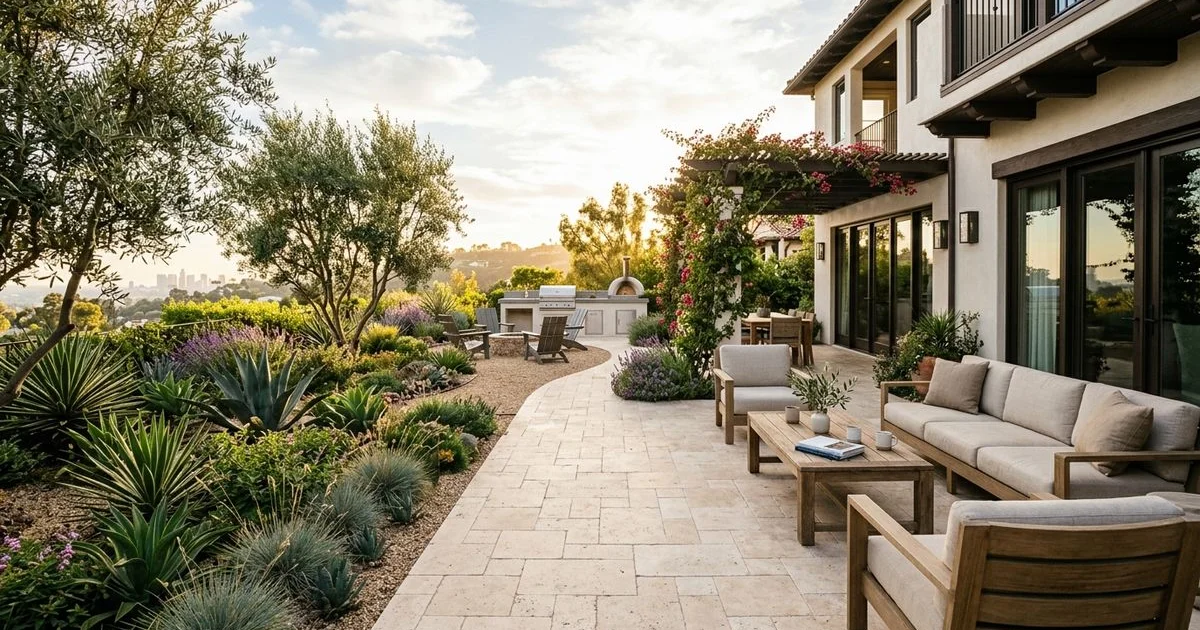
Hardscaping has a real role here, especially where the terrain is uneven. Retaining walls, steps, permeable paths, and edges can make a hillside more usable and help manage water movement. But hardscaping should support the planting plan rather than overpower it. A slope that is covered entirely in stone might look neat at first, yet it can heat up excessively and leave little room for plant roots or stormwater absorption. A better design balances structure with planting so the site stays stable, accessible, and visually soft where it needs to be.
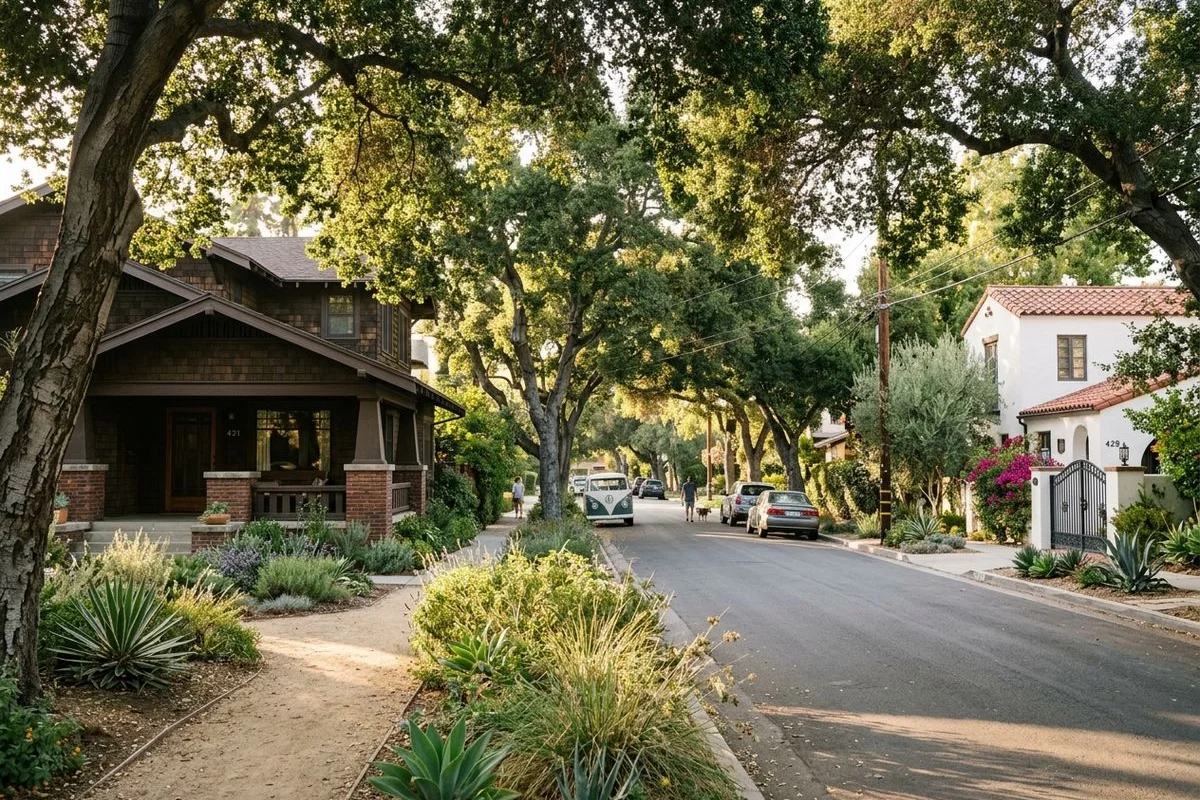
This is also where people should think about sightlines and neighborhood character. In many parts of the San Gabriel Valley, hillside landscaping contributes to the visual identity of the area. Water-efficient landscapes can preserve that character without relying on high-water turf or constant replacement planting. That matters in new construction as well, where the landscape should feel like a natural extension of the architecture and the surrounding terrain.
Firewise planning should be part of the conversation
In foothill and hillside areas, planting for water efficiency and planting for fire awareness often go hand in hand. The San Gabriel Mountains region has a very real fire context, and local native plant guidance often includes ember-resistant zone thinking, defensible space, and firewise planting. That does not mean the landscape must become sterile or stripped of character. It means the layout should be deliberate.
This is one reason to avoid crowding combustible plants right up against structures and to be cautious with dense, continuous masses in the most vulnerable areas. Plant form matters as much as species choice. A well-spaced planting with managed transitions can reduce risk better than an overgrown screen that traps heat and debris. In practical terms, this often means keeping the planting closest to the house lower and less dense, then layering outward into more naturalistic or habitat-oriented compositions where the site allows it.
That same awareness helps with maintenance. A landscape that is built with firewise principles tends to be easier to inspect, trim, and keep in order. It also tends to reveal where irrigation, pruning, and debris removal need attention, which is useful for long-term performance.
Turf removal should be planned, not rushed
Turf removal can be one of the most effective water-saving changes a homeowner makes, but it should be handled carefully. Removing grass without replacing it with a considered plan can leave bare soil exposed to heat, erosion, or runoff. On slopes, that risk increases quickly. Bare ground on a hill can wash out in the first meaningful storm if it is not stabilized.
A better approach begins with the intended function of the space. If the area is meant for gathering, children’s play, or circulation, hardscaping and a smaller planting plan may make more sense than trying to force every square foot into ornamental planting. If the area is more decorative or ecological, then drought resistant landscaping with natives and climate-appropriate species may be the better fit. In either case, the old turf irrigation usually needs to be rethought at the same time.
A common practical sequence looks like this:
That sequence is simple, but it prevents a lot of expensive mistakes. It also gives the landscape a better chance of aging well instead of merely looking finished on installation day.
HOA rules do not erase water-wise choices
Some homeowners hesitate to change landscapes because they assume an association will block water-saving options. In California, that concern is not always well founded. State water-restriction guidance says homeowners’ associations cannot prohibit certain water-efficient landscaping choices during drought-related restrictions. That does not mean every design decision is unrestricted, but it does mean water-conscious choices deserve a place at the table.
This matters because many HOA neighborhoods still benefit from plantings that are lower water, better matched to local climate, and more resilient under regional conditions. A clean, well-designed landscape using native or climate-appropriate plants can look polished and still conserve water. The best versions do not look compromised. They look intentional, composed, and tied to the surrounding terrain.
The design test I use before a plan is finalized
When a landscape plan feels complete, I like to ask whether it would still make sense if water became less generous, the summer heat ran a little stronger, or the slope shed more runoff than expected. That question quickly reveals whether the design is rooted in the site or just layered on top of it. A plan that fits the microclimate should handle those stresses without unraveling.
That is where the strongest landscapes distinguish themselves. They do not depend on constant correction. Their irrigation is zoned properly, their plant palette matches the sun and soil, their hardscaping supports access and drainage, and their slope planting does real work. They fit the property as it actually exists, not as someone hoped it might be.
For many San Gabriel Valley homes, that means combining water-wise design, hillside landscaping awareness, thoughtful hardscaping, and native or climate-appropriate plants into one coherent plan. Done well, the result is not just more efficient. It feels calmer and more believable. The property makes sense from the ground up, and that is the real advantage of designing for microclimate.