
Stormwater-Friendly Hardscaping for Residential Properties
Residential hardscaping often gets treated as a visual decision first and a water decision second. That approach leaves a lot on the table, especially in the San Gabriel Valley, where hillside character, wildfire risk, water efficiency, and stormwater control all intersect on the same property. The best hardscaping does more than look finished. It slows runoff, reduces erosion, supports irrigation efficiency, and gives a landscape structure that can handle hot, dry summers and sudden rain.
That is where stormwater-friendly hardscaping earns its keep. Pavers, retaining walls, decomposed granite paths, permeable joints, and well-placed drainage features can help a property work with the site instead of against it. On flatter lots, that may mean reducing runoff toward the street. On slopes, it often means protecting soil from moving downhill during heavy rain. On homes near foothill terrain, it can also support defensible-space planning and make room for drought-tolerant planting that belongs in the local climate.
The challenge is not simply choosing attractive materials. It is designing a surface system that respects soil, sun exposure, plant selection, and irrigation patterns before turf comes out or concrete goes in. That is the practical order of operations. Once those basics are clear, hardscaping becomes part of a larger landscape design that uses water wisely and holds up over time.
Why hardscaping matters in a stormwater-conscious landscape
When people hear “hardscape,” they often picture patios, walkways, seat walls, or a driveway. Those elements are real, but their hidden role is hydrology. A stone terrace can interrupt sheet flow. A permeable path can let water soak in rather than race downhill. A retaining wall can stabilize a grade and create a planting pocket where a slope would otherwise shed soil. Even a small change in surface material can alter how water moves across a yard during a storm.
That matters in Southern California because rainfall does not arrive in neat, gentle doses. Long dry periods can be followed by short, intense weather events that expose weak grading, compacted soil, and poorly planned downspouts. In residential landscape design, those weaknesses tend to show up where hardscape meets planting beds, where slopes meet flat areas, and where water leaves the property too quickly.
A stormwater-friendly approach does not mean avoiding hard surfaces altogether. It means using them carefully. A well-designed patio may be the thing that keeps foot traffic off vulnerable slope soils. A gravel service landscape design experts path can protect roots and reduce mud. A low wall can form a level planting terrace that supports drought resistant landscaping while keeping runoff from carving gullies through a hillside yard.
Start with the site, not the surface
The California water guidance for landscape changes makes a point that deserves more attention than it usually gets. Before removing turf or reworking a yard, it helps to assess irrigation, soil, sun exposure, and plant selection. That order sounds simple, but it saves expensive mistakes. I have seen people replace a lawn with decorative hardscape, only to discover that water from the roof and neighboring slope still pours into the same corner. The result is puddling, staining, and plant failures that have nothing to do with the plants themselves.
Soil tells you a great deal about how much hardscaping a site can absorb and where it should be kept to a minimum. Dense, compacted soil sheds water. Looser soil can absorb more, though even that depends on grade and compaction. Sun exposure matters because it affects surface heat, plant performance, and material choice. A broad stone patio on a west-facing exposure can become uncomfortably hot, while a lighter-colored permeable surface may be easier to live with. Irrigation layout matters because a hardscape change can disrupt old spray patterns, leaving overspray on walks and wasted water on walls.
The best projects begin by reading the property as a whole. Where does runoff want to go? Which areas receive the most intense sun? Which slope is most vulnerable to erosion? Which places can hold water briefly without damage, and which cannot? Those answers shape everything that comes next.
The case for permeable surfaces
Permeable hardscaping has a straightforward appeal: it gives water a path into the ground instead of forcing it to move offsite. That does not solve every drainage issue, and it is not the right choice everywhere, but it can be a strong fit for many residential properties. Permeable pavers, spaced-set stone, gravel systems, and other open-jointed surfaces can reduce runoff volume when they are properly installed and maintained.
The important part is “properly installed.” Permeable surfaces need the right base, the right slope, and the right edge treatment. If the base is poorly prepared, water can pool or the surface can shift. If the slope is too steep, water may still move too quickly for the system to be effective. If the joints fill with sediment and are never cleaned, the permeability drops. These are not reasons to avoid the material. They are reasons to treat it as infrastructure, not decoration.
For residential properties in the San Gabriel Valley, permeable surfaces are especially useful in the transition zones of a yard. Think about side yards, short walks, driveway margins, and seating areas near planting beds. Those are often the places where water can be slowed without sacrificing usability. A full paved expanse is rarely necessary. Often, a carefully placed strip of permeable surface does the job better while keeping the landscape lighter and more climate responsive.
Hillside landscaping asks for a different mindset
Slope changes everything. Hillside landscaping in foothill communities brings beauty and risk in equal measure. Gravity does the work of moving water downhill, which means erosion shows up fast when soil is left exposed or when hardscape interrupts the grade without a plan. The California Native Plant Society has long emphasized that slopes need erosion control, drought tolerance, and firewise planting. That is exactly the right frame for residential hillside work.
On a slope, hardscaping is not only about convenience. It is often a structural response to a difficult site. Terraces, retaining walls, steps, and drainage breaks can turn a problematic hillside into usable space. But each of those elements needs to be designed with water movement in mind. A retaining wall without proper drainage can create pressure behind it. A stair run without adjacent planting can accelerate runoff along its edges. A bare slope between hardscape elements can become a washboard after the first strong rain.
The smartest hillside projects pair hard surfaces with plant roots. Hardscape provides the skeleton, while the planting stabilizes the skin of the slope. California buckwheat, California sagebrush, manzanita, ceanothus, monkeyflower, foothill penstemon, and bunchgrasses are all examples of plants that fit naturally into this broader approach in local gardens. These are not ornamental afterthoughts. They are part of the slope’s long-term defense.
Water-wise design and the reality of turf removal
Turf removal is often where homeowners first start thinking seriously about hardscaping. The temptation is to replace grass with a large patio or a field of decorative gravel. Sometimes that works. Often it does not. The better question is what the space needs to do after the turf is gone.
California’s landscape guidance points people toward evaluating irrigation, soil, sun exposure, and region-appropriate plant water needs before changing the site. That is the right sequence because turf removal changes water dynamics. A lawn once absorbed and distributed irrigation across a broad area. Once it is gone, the remaining landscape may need targeted irrigation retrofits, a revised layout, or entirely different drainage logic.
A hardscape-heavy replacement can reduce maintenance, but it can also create heat buildup and increase runoff if it is overused. A more balanced approach often works better. Some of the old lawn becomes planting area for climate-appropriate species. Some becomes permeable path or terrace space. Some stays open only where foot traffic justifies it. That mix usually looks more natural, performs better in summer, and aligns more closely with drought tolerant landscaping goals.
The state’s Model Water Efficient Landscape Ordinance also matters here. It encourages water-efficient practices in new and renovated landscapes, including native or climate-appropriate plants and efficient irrigation. For homeowners planning a major remodel, that means hardscaping should not be treated as a separate aesthetic layer. It is part of a water budget mindset, one that values every square foot according to how it handles heat, runoff, and irrigation demand.
Firewise planning and hardscaping can work together
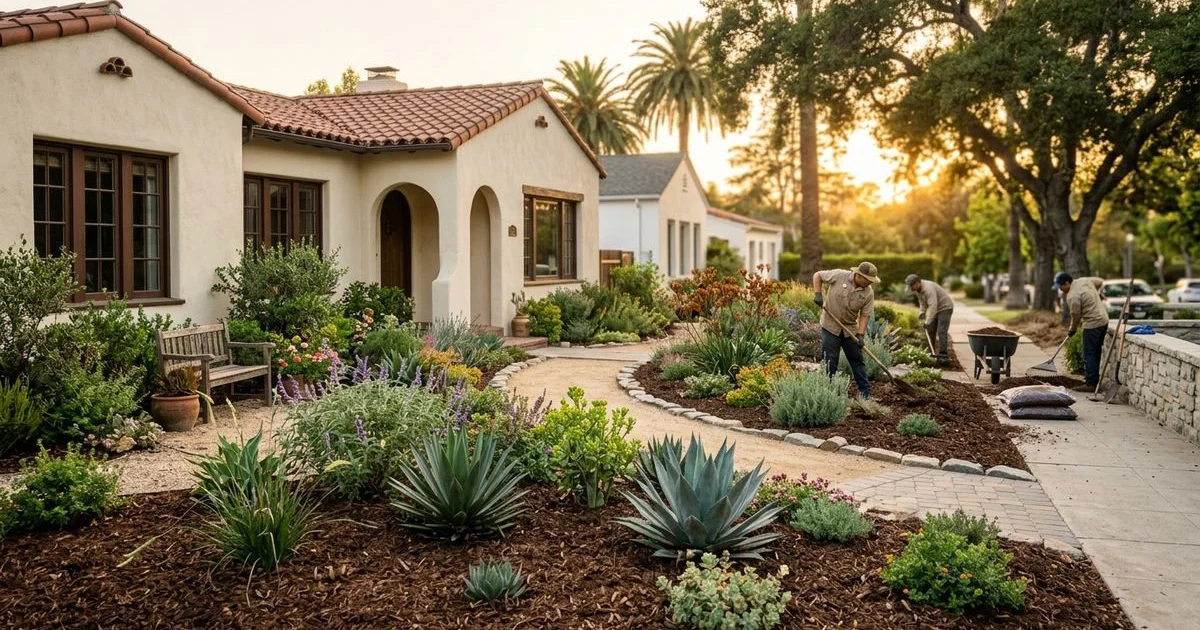
In wildfire-prone areas, hardscaping often does more than manage water. It can support defensible-space planning by creating separation between structures and vegetation, giving clear access paths, and reducing the amount of combustible material directly beside the home. Around the San Gabriel Mountains and other foothill settings, this matters. The local landscape is beautiful, but it is also shaped by fire risk and sensitive habitat.
Hardscape should not be used as a blunt substitute for plant planning. Bare expanses alone do not make a landscape safe or appealing. Still, the right arrangement of hard surfaces can create practical buffers near structures, patios, and entryways. A paved or stone zone near the house can help reduce the concentration of plant material in ember-exposed areas, while thoughtfully chosen native planting beyond that zone can maintain ecological character without crowding the building envelope.
This is where judgment matters. A homeowner can overdo it and end up with a landscape that is technically “safe” but harsh, reflective, and difficult to live with. Or the design can stage transitions, using hardscape close to the house and increasingly softer, drought-tolerant planting farther out. That kind of gradient tends to feel more coherent and more resilient.
The overlooked role of irrigation retrofits
Irrigation and hardscaping are tightly linked, even when they appear separate on paper. The moment you change a surface, you change how water behaves around it. A new wall can alter spray coverage. A widened path can block an old emitter layout. A permeable patio may need a different watering strategy in the nearby planting beds because water now infiltrates rather than running elsewhere.
This is why irrigation retrofits should be part of the hardscaping conversation from the start. Drip systems, properly zoned controllers, and corrected overspray can make a water-wise landscape function much more efficiently than a patchwork of old heads trying to serve a redesigned site. On residential properties, this often shows up as a series of small corrections rather than a dramatic overhaul. A spray head gets moved. A valve zone gets split. A shrub bed gets drip instead of overspray. Those modest adjustments can make a major difference in water use and plant health.
One practical truth is worth stating plainly: hardscaping often exposes irrigation problems that turf once concealed. A lawn can tolerate a lot of excess water. A native planting bed cannot. Once the turf is gone, the system has to become more precise.
Planting and hardscaping should be designed as one system
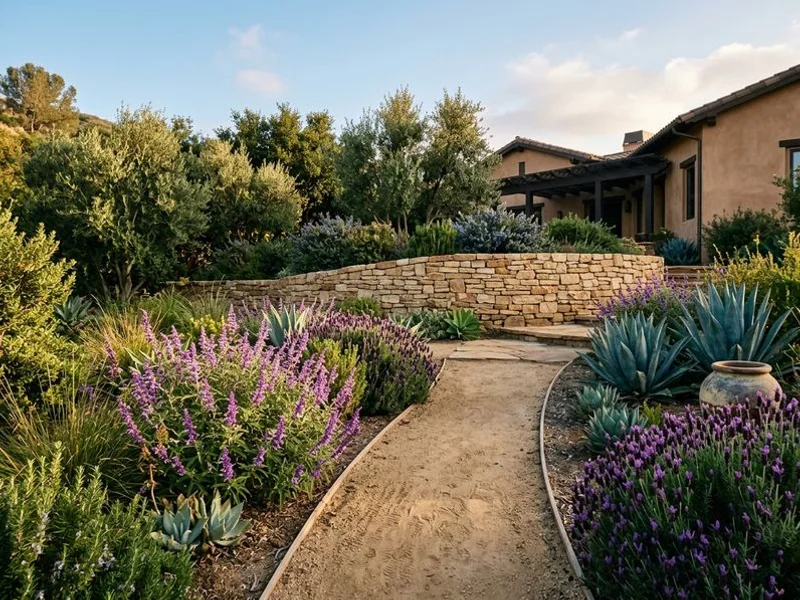
The strongest residential landscapes do not separate hardscape from planting. They choreograph them together. A retaining wall creates a shelf for manzanita. A decomposed granite path curves around a patch of monkeyflower. A low terrace frames bunchgrasses that soften the edge of a courtyard. In that kind of design, the hardscape is not a foreign object. It is the support structure for the planting palette.
That relationship is especially valuable on properties with mixed conditions. A slope may be hot and dry at the top, shaded near the house, and vulnerable to runoff in the middle. Different microclimates can be handled with different materials and plant choices. Soil exposure, wind, reflected heat, and roof runoff all affect what will thrive where. The better the design reads those variables, the fewer maintenance surprises appear later.
There is also a visual benefit. The San Gabriel Valley has a distinct hillside character, and new construction often looks best when it respects that setting rather than flattening it into a generic suburban formula. Native and climate-appropriate planting paired with restrained, functional hardscaping tends to fit the region better than oversized lawns or excessive ornamental paving. That is true aesthetically, but it is also true ecologically and practically.
HOA rules and homeowner rights
Homeowners in HOA communities sometimes assume that association rules override water-efficient landscape choices. That is not always the case. California water-restriction guidance says homeowners’ associations cannot prohibit certain water-efficient landscaping choices during drought-related restrictions. For people trying to make a property more sustainable, that matters.
The practical takeaway is not that every hardscape or planting decision is automatically approved. It is that water-wise design has recognized standing in California, especially during periods of restriction. Homeowners still need to work through architectural review or association processes where applicable, but they should not be discouraged from exploring drought tolerant landscaping, efficient irrigation, or appropriately designed hardscaping simply because it changes the look of the yard.
That can be especially important for front yards, where curb appeal, water conservation, and neighborhood standards often collide. A thoughtful design can satisfy all three. It may use more native planting, a smaller lawn footprint, and a hardscape layout that reduces runoff while preserving a polished appearance.
Practical choices that usually age well
A residential project does not need to solve every issue with one material. The most durable landscapes usually combine several modest moves, each doing a specific job well. In practice, that often means a few choices carry most of the benefit:
- Permeable walks or patio zones where water can infiltrate instead of sheet-flowing downhill
- Terracing or low retaining walls on slopes to control erosion and create level planting pockets
- Drought-tolerant and native planting around hardscape edges to soften heat and stabilize soil
- Irrigation retrofits that match the new layout instead of forcing old spray patterns to survive
- Clear drainage paths that keep stormwater away from structures and vulnerable slope areas
Those decisions sound simple because they are. The hard part is making them work together. A patio that drains well but overheats may be unpleasant. A beautiful slope planting may fail if the runoff pattern is ignored. A retaining wall without drainage can become a liability. Good landscape design is usually a matter of balancing these pieces without overbuilding.
What stormwater-friendly hardscaping looks like on the ground
A finished project does not have to announce itself loudly to be effective. On a well-planned property, stormwater-friendly hardscaping often feels quiet and intentional. A side yard path stays firm after rain instead of turning muddy. A terrace catches slope movement and gives the planting a place to root. The front yard looks cleaner, but water does not race toward the curb in the first hard storm. The home sits in a landscape that feels native to the climate because the materials, planting, and irrigation all agree with one another.
That is the real value of this kind of work. It makes the property easier to live with in summer, safer during storms, and more resilient over time. It also gives homeowners a way to improve both appearance and function without ignoring the realities of local water use, hillside conditions, and firewise planning. In the San Gabriel Valley, those realities are not side notes. They are the baseline.
When hardscaping is shaped by stormwater, slope, and drought, it stops being just the “built” part of the yard. It becomes the part that lets the whole landscape work.